
If you’ve ever dabbled in crypto, you know how overwhelming the markets can be. Prices move fast, news hits 24/7, and emotions can swing just as wildly as Bitcoin’s chart. For many traders, the big question becomes: Do I keep making decisions manually, or should I let technology take over with an automated trading bot?
Both approaches—manual trading and automated trading—have their place. The “right” one depends on your goals, risk tolerance, and trading style. In this article, we’ll break down the pros and cons of each, so you can decide which path fits you best.
What Is Manual Trading in Crypto?
Manual trading means you’re the one calling the shots. You study charts, watch market news, set buy and sell orders, and decide when to enter or exit trades.
Advantages of manual trading crypto:
- Full control: You make every decision, so you’re not leaving profits or mistakes up to a program.
- Flexibility: You can adapt on the fly to unexpected news, government regulations, or sudden shifts in market sentiment.
- Learning experience: Manual trading sharpens your understanding of technical analysis, risk management, and market psychology.
Challenges of manual trading:
- Time-consuming: Crypto never sleeps. To stay competitive, you might find yourself glued to your screen.
- Emotional bias: Fear of missing out (FOMO) or panic selling can lead to poor decisions.
- Inconsistent results: Unless you’re extremely disciplined, your performance can vary day to day.

What Is Automated Crypto Trading?
Automated trading uses algorithms or bots to execute trades on your behalf. Once you set the parameters—like entry and exit points, stop losses, or indicators—the bot runs around the clock.
Advantages of automated trading bots:
- 24/7 operation: Bots never sleep, which is critical in crypto’s always-on market.
- Emotion-free decisions: No fear, no greed—just data-driven execution.
- Backtesting & consistency: Bots can test strategies on historical data and stick to rules without deviation.
- Scalability: You can manage multiple trading pairs or exchanges simultaneously.
Challenges of automated trading:
- Technical knowledge required: Setting up and fine-tuning bots takes some skill.
- Costs: Some bots or platforms require subscriptions or fees.
- Over-reliance on tech: Bots can’t predict black-swan events like major hacks or regulatory crackdowns.
- False security: A bot is only as good as the strategy behind it. Poor input equals poor results.
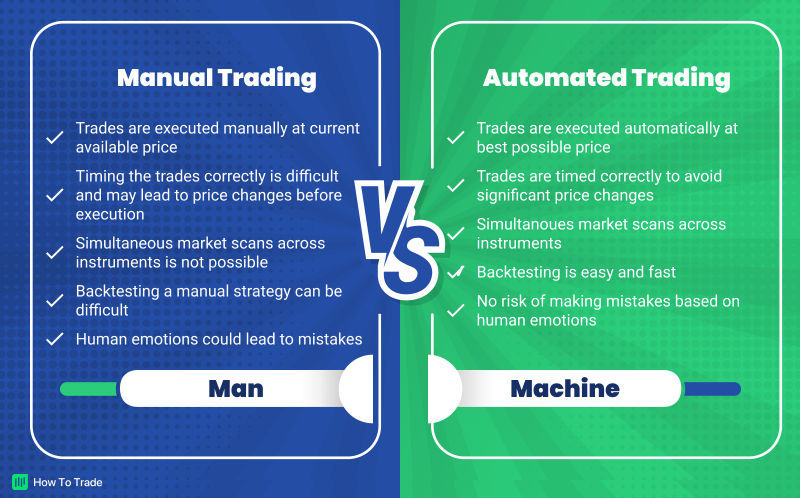
Key Differences Between Manual and Automated Trading
Feature Manual Trading Automated Trading
TradingControl 100% trader decision Pre-set rules via bot
Time Demand High – constant monitoring Low – runs automatically
Emotion Factor High – human psychology Low – data-driven only plays in
Flexibility Can adapt instantly Limited to programmed rules
Learning Curve Focused on trading skills Focused on tech setup & strategy design
Which Approach Fits Your Style?
Ultimately, deciding between manual and automated trading isn’t about which is “better.” It’s about which aligns with you.
Choose manual trading if…
- You enjoy analyzing charts and being hands-on.
- You want to develop strong trading instincts.
- You don’t mind spending hours tracking markets.
Choose automated trading if…
- You prefer efficiency and consistency.
- You want to remove emotional bias.
- You can dedicate time upfront to setting up and testing strategies.
Some traders even combine both methods. For example, they may use bots for repetitive tasks like dollar-cost averaging (DCA) but keep manual control over high-risk trades.
Common Myths About Automated Trading Bots:
“Bots guarantee profits.” Not true. A bot executes a strategy—it doesn’t create a winning one.
“You need to be a coder.” Many platforms offer user-friendly interfaces where no coding is required.
“Bots are risky.” They can be, but so can manual trading. Risk depends on your setup and discipline.
Final Thoughts
The crypto market is fast, global, and emotional. Manual trading lets you sharpen your skills and maintain control, while automated crypto trading provides discipline and 24/7 execution.
There’s no one-size-fits-all answer. Some traders thrive on the adrenaline of hands-on decisions. Others prefer letting data and automation lead the way. The key is to experiment, start small, and choose the method that helps you reach your financial goals without burning out.
Key Takeaway: Whether you trade manually or with automated trading bots, the “right” approach is the one that fits your lifestyle, not just the market’s speed.
